Short answer: A commercial truck dealership needs software that tracks floor plan cost per serial number, manages manufacturer warranties, runs a high-volume workshop, and integrates parts with service in real time. A generic ERP covers administration but not the full operational reality of this sector.
A commercial truck dealership operates in a market where the customer isn’t buying a vehicle — they’re buying uptime. The fleet operator needs their units on the road as much as possible, with minimal workshop downtime and predictable costs. If the dealership can’t deliver on that in service, there’s another one willing to try.
That pressure defines what the management system needs to do. It’s not enough to manage inventory and process sales — the system has to support the full operation: floor plan financing, manufacturer warranties, high-volume workshop, and an integrated parts warehouse.
What Makes This Sector Different
Floor Plan Financing for Commercial Trucks
New truck inventory at a dealership is financed — either by a bank or directly by the manufacturer. Every unit on the lot carries a daily financial cost from the moment it arrives. If the system doesn’t track that cost per unit — how much has accrued, when it comes due, which units have been sitting too long — management is making pricing and discount decisions without seeing the real cost.
A specialized system logs floor plan by serial number, calculates accrued financial cost, and alerts when a unit exceeds defined time or cost thresholds.
Manufacturer Warranties
Truck warranties have specific terms and conditions by brand: mileage covered, components included, documentation requirements for filing a claim with the manufacturer. If that process is managed manually, claims get lost due to missing documentation or missed deadlines.
The right workflow links the warranty to the unit’s serial number, records the diagnostics and parts involved, and generates the manufacturer claim documentation with the data each brand requires.
File by Serial Number
Each truck has a unique history: what services have been done, what parts were replaced, whether it was under warranty, which customer it was sold to. That file must be linked to the serial number and accessible from the work order — not scattered across paper records or separate systems.
When a technician opens a new work order, they should be able to see the unit’s complete history in seconds — what work was done before, what prior diagnostics exist, any relevant background.
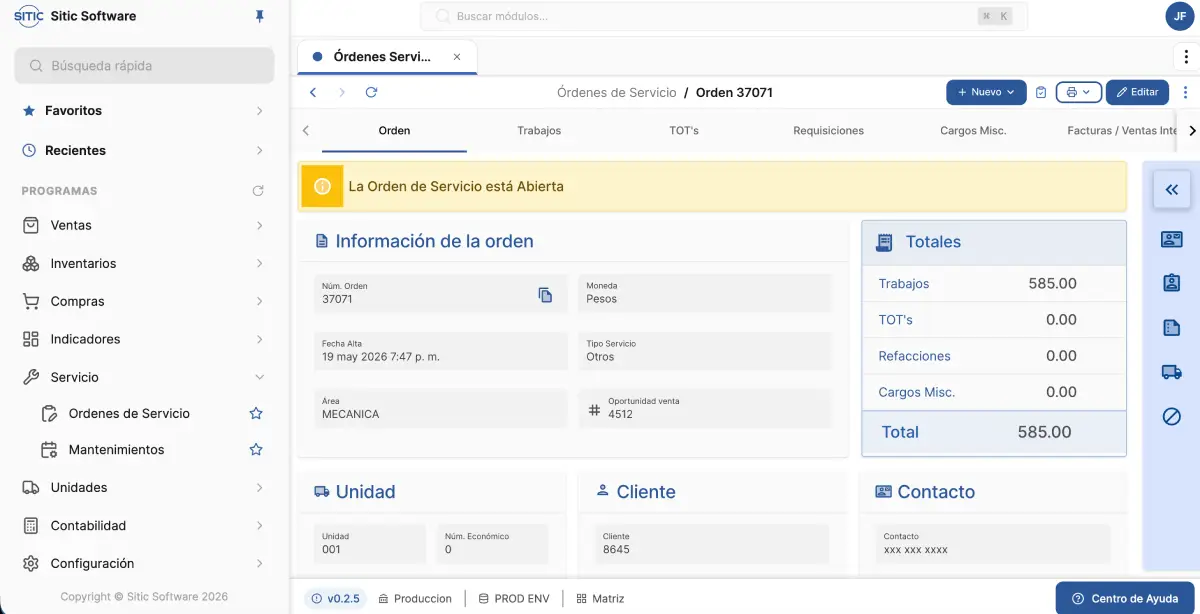
The Service Workshop at a Truck Dealership
Truck workshops run at high volumes with intense time pressure. A truck in the shop is a truck not generating revenue for the fleet operator. Every additional hour has a real cost for the customer and a direct impact on the commercial relationship.
Workshop efficiency isn’t just an internal metric — it’s part of the value proposition. The dealership that promises turnaround times and delivers on them retains customers. The one that consistently extends promised timelines loses them.
The metrics that matter here are clear: average cycle time by service type, percentage of orders delivered on the promised date, return rate for jobs not resolved on the first visit. A system that logs the time of each event in the order — opened, technician assigned, parts requested, completed, delivered — can calculate those metrics automatically.
Parts Integrated with the Workshop
The parts warehouse has to communicate with the workshop in real time. When a technician needs a part for an active order, the system should show availability, process the warehouse dispatch, and log the cost to the work order — without a manual process in between.
If those two processes live in separate systems or parallel spreadsheets, errors accumulate: parts used but not recorded, costs not captured, inventory out of date. The result is that the real cost of each work order becomes impossible to calculate.
For trucks, there are high-turnover wear components: brakes, filters, transmissions. A system that tracks dispatches by reference can calculate automatic reorder points and prevent stockouts on the most critical parts.
The Information Leadership Needs
In a truck dealership with a mixed operation — sales, workshop, parts — leadership needs to see profitability by business line separately.
Is the workshop profitable on its own, or does it depend on unit sales margins? Do parts have the right rotation and margin? Which location operates with the highest service efficiency?
Those questions only have answers when the system captures the real cost of every transaction and groups it in a way that leadership can review without relying on manual reports.
If you’d like to see how SITIC manages the operations of truck dealerships, schedule a demo with our team.