Short answer: Floor plan financing generates a daily financial cost per unit in inventory that must be allocated to the unit’s cost to calculate the real margin on every sale. Without that unit-by-unit tracking, profitability is overstated and pricing decisions are made on incomplete data.
The business model of a heavy equipment dealership has a financial characteristic that few industries share: the most valuable assets in the business — units in inventory — are financed by third parties. The floor plan lets you carry millions of dollars in machinery inventory without needing that capital yourself. But it carries a cost that runs from the moment the unit enters inventory to the moment it sells.
Managing that cost correctly — recording it, monitoring it, including it in the margin calculation for every sale — is the difference between having real financial clarity or believing you’re generating margins that don’t actually exist.

How the Floor Plan Works and Where Control Breaks Down
The floor plan is essentially a revolving line of credit: the financial institution pays the manufacturer for the units the dealership orders, and the dealership has a set period to sell those units and pay off the credit. While the unit sits in inventory, it generates a financial cost that typically doesn’t show up in operational reports — it only appears in the accounting income statement.
The management problem occurs when that financial cost isn’t allocated to the specific unit in the operational system. The dealership sells a unit, calculates the margin as sale price minus invoice cost, and that margin looks fine. But if the unit spent six months on the floor plan, the financial cost of those six months isn’t included in the calculation. The real margin is lower — and in some cases, negative.
The Cost of Days in Inventory
Every day a unit is on the floor plan has a cost. A $200,000 machine with an 18% annual floor plan rate generates approximately $98 per day in financial cost. Over 120 days, that’s nearly $12,000 in financial cost that must be included in the unit’s cost to calculate the real margin on the sale.
When that calculation isn’t done systematically — unit by unit, from the date it entered inventory to the date it sold — the business’s profitability is overstated.
Maturity Alerts and Renewals
The floor plan has deadlines. When a unit doesn’t sell within the agreed period, there are consequences: the lender may demand payoff, may apply penalty rates, or may require renewal under more costly terms.
Without a system that alerts on upcoming maturities with enough lead time, the dealership operates reactively: it learns about maturities when the lender notifies them, not when there’s still time to act. That advance notice — knowing which units are approaching their deadline — enables real decisions: adjust the price to accelerate the sale, request renewal early, or relocate the unit to another location where demand is higher.
Customer Credit: The Other Financial Side
In addition to the floor plan, many dealerships offer financing to their customers. Whether using their own capital, acting as an intermediary for a financial institution, or through manufacturer programs, there are credit lines the dealership manages or administers.
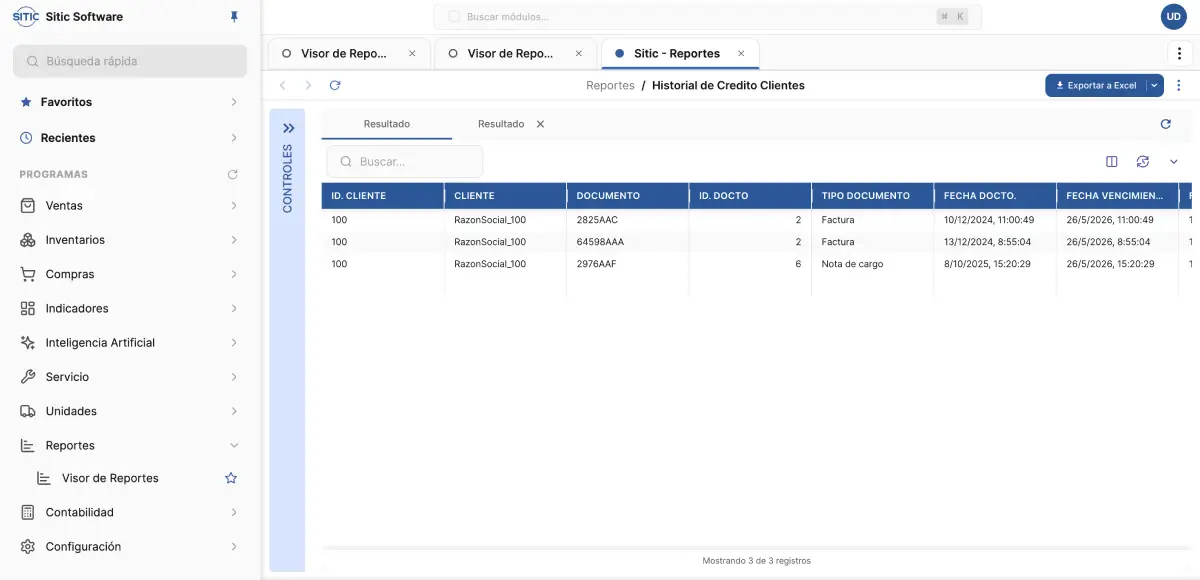
Those credits have a lifecycle the system must track: credit terms, amortization schedule, payments received, outstanding balance, days past due. If that information lives in separate spreadsheets or in the accounting system without being linked to the customer file, the credit portfolio is opaque.
Portfolio visibility is particularly important for detecting at-risk accounts before they reach default. A customer with a history of on-time payments who suddenly missed two installments is a signal that warrants a proactive call. That pattern is impossible to detect if the portfolio data isn’t centralized.
Integrating Floor Plan Cost Into Real Profitability
The correct way to measure the profitability of a unit sale in a heavy equipment dealership is:
Sale price minus manufacturer invoice cost minus preparation expenses minus accumulated floor plan financial cost minus salesperson commission = real margin on the transaction
When the system calculates that margin automatically at the moment the sale closes — because it has all those components recorded — the sales director can see in real time which transactions were profitable and which weren’t. That visibility changes business review conversations: instead of talking about approximate gross margins, you talk about real profitability per transaction.
If you want to see how SITIC manages floor plan and customer financing in heavy equipment dealerships, schedule a call with our team.