Short answer: Real profitability by unit, work order, or branch isn’t visible because the data lives scattered across sales, the shop, parts, and accounting. You recover it by defining the sold unit, the work order, and the branch as the real level of analysis, connecting floor plan financing cost to each sale, tying parts and labor to each work order, and reviewing branch profitability as often as you review total sales.
Ask any heavy equipment dealership owner or director if their business is profitable, and almost all will say yes. Ask exactly how much the last unit they sold actually earned (after discounts, commissions, floor plan financing cost, warranty expense, and prep) and the answer is almost always far less precise.
It’s not because the business isn’t profitable. It’s because the information needed to know for certain is scattered across sales, the shop, parts, finance, and accounting, and it almost never comes together in one place in time to make decisions.

The Problem Isn’t a Lack of Data, It’s That It’s Scattered
Most heavy equipment dealerships do have the information needed to calculate their real profitability. The problem is it lives in different systems or files that don’t talk to each other:
- Sales knows the sale price and the discount given, but not always the real financing cost of that unit (floor plan interest, time in inventory).
- The shop knows how much labor and parts cost on a work order, but isn’t always connected to what was billed to the customer.
- Parts knows what was sold and what was consumed internally, but doesn’t always clearly separate the two in margin reports.
- Accounting has the final numbers, but usually at a very aggregated level (by month, by account), not by unit, work order, or technician.
The result is that “real” profitability gets rebuilt by hand, weeks later, using information that’s already lost its value for making timely decisions.
The Questions You Should Be Able to Answer in Minutes (and Probably Can’t)
If you struggle to answer any of these without asking someone to build a special spreadsheet report, it’s a clear sign that your information is more fragmented than it should be:
- What was the real margin on the last unit sold, including floor plan financing cost?
- Which work orders lost money this month, and why?
- Which branch is most profitable, and which one is quietly subsidizing the rest?
- How much is it costing the company for units to sit in inventory before they sell?
- Which technician or service type generates the most rework and warranty claims?
Why This Matters More Than It Seems
When real profitability isn’t visible in time, decisions get made on incomplete information: you keep selling at the same discount level even though the margin no longer supports it, you keep a branch open that’s actually running in the red, or you keep absorbing a warranty cost that should be negotiated differently with the manufacturer.
This isn’t a lack of effort from the admin team: it’s a structural problem of having information split across systems that don’t share the same business logic.
How to Start Putting the Puzzle Together
- Define your business’s real unit of analysis: it’s not “the month,” it’s the sold unit, the work order, and the branch. Every report should be able to break down to that level.
- Connect financing cost to the sale. A unit’s margin isn’t complete without including how much it cost to keep it financed under the floor plan for however long it sat in inventory.
- Tie every part and every labor hour to its work order, and every work order to its invoice, so you can calculate real shop margin without rebuilding it by hand.
- Clearly separate sales, warranty, and internal consumption in your parts reports: mixing these three categories is one of the most common causes of parts margins that “don’t add up.”
- Review branch profitability as often as you review total sales, not just at the end of each quarter.
From Rebuilt Reports to Real-Time Information
The common thread through all of this is that a heavy equipment dealership’s real profitability can only be seen clearly when sales, the shop, parts, floor plan, and accounting share the same base of information, not when each department has its own file and someone has to piece it together by hand every month.
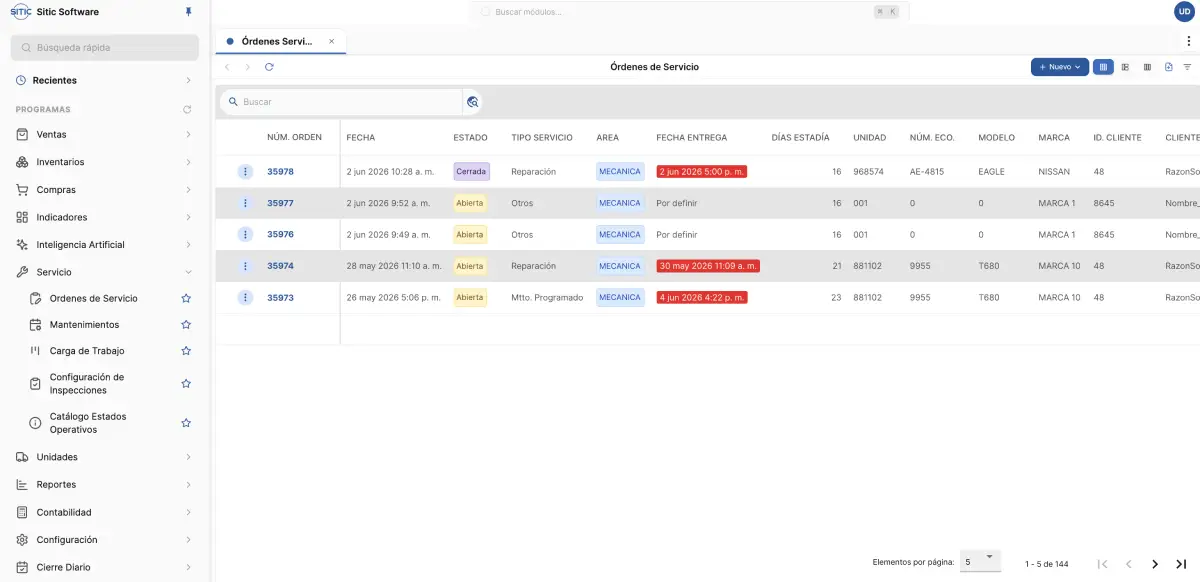
That’s exactly the problem a system designed specifically for this kind of operation solves, like SITIC Software, which integrates units, the shop, parts, floor plan, and BI in a single platform, so profitability by unit, work order, or branch is available in real time instead of rebuilt weeks later.
If you’d like to see how SITIC shows real profitability by unit, work order, and branch, schedule a demo with our team.
Frequently Asked Questions
Why does my accounting show a profit, but I don’t know which units or branches are generating it?
Because accounting traditionally aggregates information by account and period, not by operational business unit (sold unit, work order, branch). You need an additional layer of operational detail, connected to accounting, not a replacement for it.
How do I include floor plan financing cost in each unit’s margin?
By recording accrued interest per unit, not in aggregate, from the moment it enters inventory until it’s paid off, and adding it to the unit’s cost before calculating sale margin.
How often should I review branch profitability?
Ideally monthly at minimum, and weekly if your volume justifies it. Waiting until year-end to discover a branch is operating at a loss costs far more than catching it early.