Short answer: Serial number traceability links every sale, service visit, replaced part, and warranty claim to the unit’s unique identifier. It speeds up diagnostics, supports manufacturer warranty disputes, and makes service history visible when reselling used equipment. Without it, every workshop visit starts from zero.
In the heavy equipment business, every unit has a story: when it was manufactured, when it was sold, to which customer, what services it has received, what parts have been replaced, whether it had warranty coverage, and what the diagnoses were at each workshop visit. That story isn’t just interesting — it’s operationally valuable, and in some cases, legally relevant.
The problem is that in most dealerships, that story doesn’t exist as a coherent, accessible record. It lives fragmented: part in the sales system, part in the workshop, part in someone’s email, part in the memory of the technician who has serviced it. When the unit arrives at the workshop, someone has to reconstruct that history from scratch.
What serial number traceability is and why it matters
Serial number traceability means that every relevant event in a unit’s life is recorded and linked to its unique identifier: the serial number or VIN. From arrival at the dealership, through the sale, to every service visit or warranty claim.
When this traceability exists, anyone with system access can answer in seconds:
- When was this unit sold and to whom?
- What services has it had and with what results?
- Does it have active warranties and of what type?
- What parts have been replaced and how many times?
- Has it had this same problem before?
Without traceability, all of those questions require manual investigation — if they can be answered at all.
The unit’s service history as an operational asset
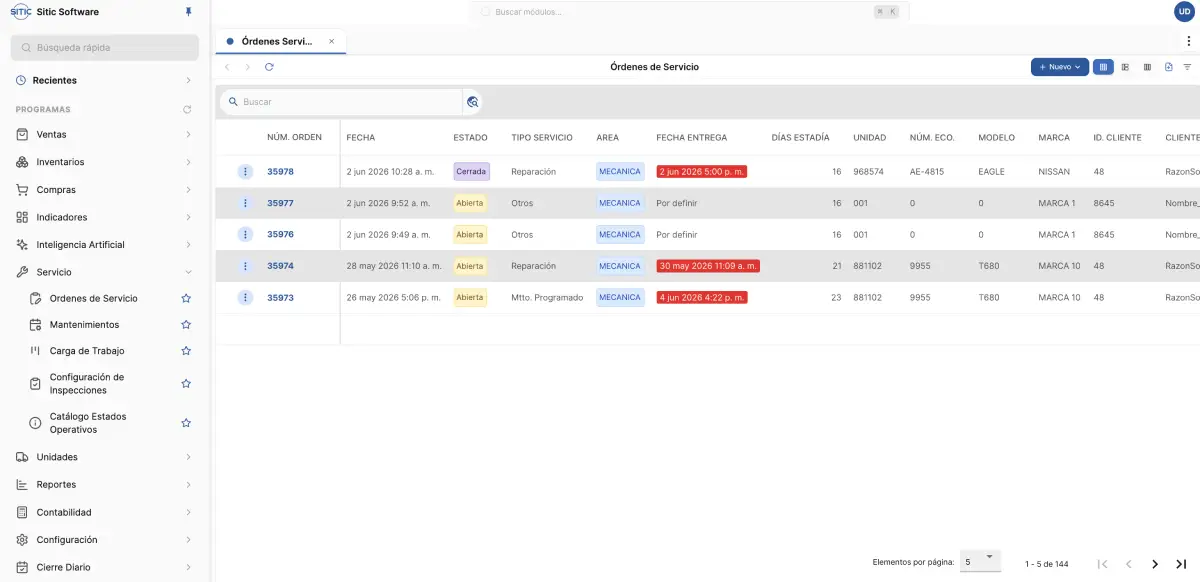
The complete history of a unit isn’t just historical information — it’s an asset that improves the quality of every future interaction. When a technician opens a service order and can see that the same unit has already come in twice with the same symptom, the diagnostic hypothesis changes. You’re not starting from zero — you’re building on what’s already known.
This has a direct impact on diagnosis time and first-visit resolution rates. Workshops with complete unit histories resolve more problems on the first visit because the technician arrives with context, not without information.
For the customer, the difference is noticeable: they don’t have to explain what already happened, they don’t have to bring paperwork from previous services, and the feeling that “they know how my machine is doing” builds trust.
The risks of not having traceability
Warranties and disputes with the manufacturer
When a manufacturer questions whether a service was performed correctly or whether a part was under warranty at the time of failure, the dealership needs to demonstrate what was done and when. Without traceable records, that demonstration is impossible. The result is a lost warranty claim, or a dispute that consumes time and resources.
Repeated diagnoses and unnecessary costs
Without history, every workshop visit starts from zero. The technician runs diagnostics that were already done before, requests parts that were already replaced, and in some cases applies solutions that already proved not to work. That time and those parts have a cost — charged either to the dealership or the customer. Neither is efficient.
Lack of visibility in used unit sales
When a dealership buys used units to resell, or takes units in trade-in, the service history of that unit is part of its value. Without traceability, that value is invisible — the dealership can’t demonstrate that maintenance was performed correctly or that the unit doesn’t have recurring problems.
How to implement real traceability in your operation
Serial number traceability requires two conditions: a system that supports the data model (a file per unit, not just per generic product), and capture discipline — meaning every event is recorded in the system at the moment it occurs.
The second condition is the hardest to maintain without the right system. When recording history is an additional step not integrated into the natural workflow, it gets skipped under pressure. When it’s integrated — the technician can’t close the order without recording the diagnosis, the work performed, and the parts used — capture happens consistently.
If your dealership already manages service digitally but unit history isn’t available in a centralized way, that’s the first improvement point. Talk to our team at SITIC to review how we build complete traceability from day one of implementation.