Short answer: Floor plan and accounting fall out of sync for five typical reasons: sold units that aren’t removed from the line on time, interest calculated by hand, missing serial-number traceability, unmonitored curtailment deadlines, and reconciliations that aren’t periodic. It’s fixed by registering every unit by serial number, connecting the sale to the payoff automatically, and reconciling against the bank every week, not just at month-end.
It’s one of the most common, and most expensive, headaches for any dealership that finances its unit inventory with a floor plan: month-end closes and the credit line numbers don’t match what your accounting says. A unit that already sold still shows as financed. Accrued interest doesn’t match the bank or lender’s statement. Nobody is sure exactly how much capital is really “tied up” on the floor right now.
If this sounds familiar, you’re not alone: it’s one of the most frequent sources of friction between sales, administration, and the bank or lender providing the floor plan.
Why Floor Plan Is So Prone to Getting Out of Sync
A floor plan is, at its core, a revolving credit line secured by your unit inventory. Every unit that enters your inventory gets “drawn” against that line, and every unit that sells has to be paid off (curtailment) against that same line, usually within a specific window after the sale.
The problem is that this involves at least three processes that are almost never in the same system:
- Sales, which tracks when a unit actually sold.
- Finance/treasury, which manages payments and payoffs to the bank or lender.
- Accounting, which has to correctly reflect the liability and financing cost of each unit.
When these three processes live in different systems (or worse, in spreadsheets someone updates “when they have time”), it’s only a matter of time before discrepancies show up.
The 5 Most Common Causes of Mismatch
1. Sold units that weren’t removed from the floor on time
If sales closes a deal but nobody notifies whoever manages the floor plan right away, the unit stays “alive” on the credit line, accruing interest on something that’s no longer yours.
2. Interest calculated manually
When accrued interest is calculated by hand or in a separate spreadsheet, it’s easy for rounding errors, outdated rates, or simply losing track of specific units to add up.
3. Missing serial-number traceability
Without a VIN or serial-number record tying each unit to its specific draw on the credit line, it’s nearly impossible to reconcile precisely which unit corresponds to which financed amount.
4. Unmonitored curtailment deadlines
Most floor plan lines have a deadline before a unit “ages” on the floor and starts generating penalties or different terms. Without automatic alerts, these deadlines get caught too late.
5. Reconciliations done “whenever there’s time”
If reconciliation between your internal system and the bank or lender’s statement isn’t a periodic, systematic process, small differences pile up until they become a big problem that’s hard to trace back to its origin.

How to Start Fixing It
- Register every unit by serial number as soon as it enters inventory, with its financing source, draw date, rate, and term: not as a lump sum, but unit by unit.
- Connect the sale to the floor plan payoff automatically. The moment a unit is invoiced, the system should be able to generate (or at least flag) the corresponding payoff instruction.
- Automate accrued interest calculation per unit, not in aggregate, so you can pinpoint exactly which unit is costing more than expected.
- Set up periodic reconciliation (ideally weekly, not just monthly) between your internal record and the lender’s statement.
- Set curtailment alerts for units approaching their deadline, before they trigger penalties.
When the Problem Is No Longer Process, But System
You can solve a lot with discipline and a good spreadsheet, up to a point. The limit shows up once you have dozens or hundreds of units on the floor, several branches, and several credit lines with different lenders at the same time. At that point, you need a system that treats floor plan for what it is: a day-to-day operational process, not a financial report assembled at month-end.
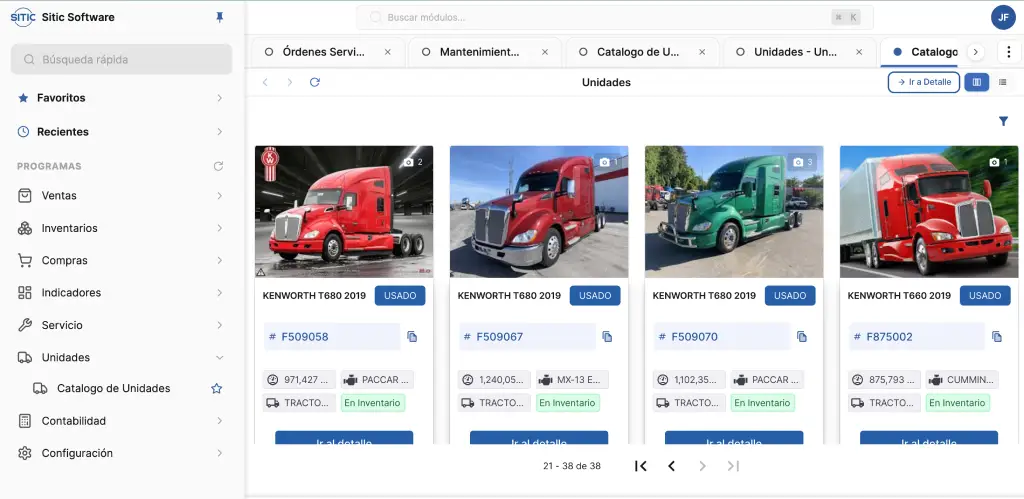
That’s one of the reasons specialized systems for heavy equipment dealerships exist, like SITIC Software, which natively connects unit sales, floor plan financing, and accounting, instead of relying on manual reports to reconcile everything at the end.
If you’d like to see how SITIC manages floor plan and accounting reconciliation at heavy equipment dealerships, schedule a call with our team.
Frequently Asked Questions
How often should I reconcile my floor plan against the bank or lender?
Ideally every week. Waiting until month-end lets errors accumulate and makes it much harder to identify which specific unit caused the difference.
What minimum information should I record for each financed unit?
Serial number/VIN, lending institution, amount drawn, rate, draw date, curtailment deadline, and status (in inventory, sold, paid off).
Is it normal to have small differences between my accounting and the bank statement?
Minor differences from processing timing can happen, but if the differences are recurring or growing month over month, it’s a sign that the reconciliation process, not just the record-keeping, needs a review.